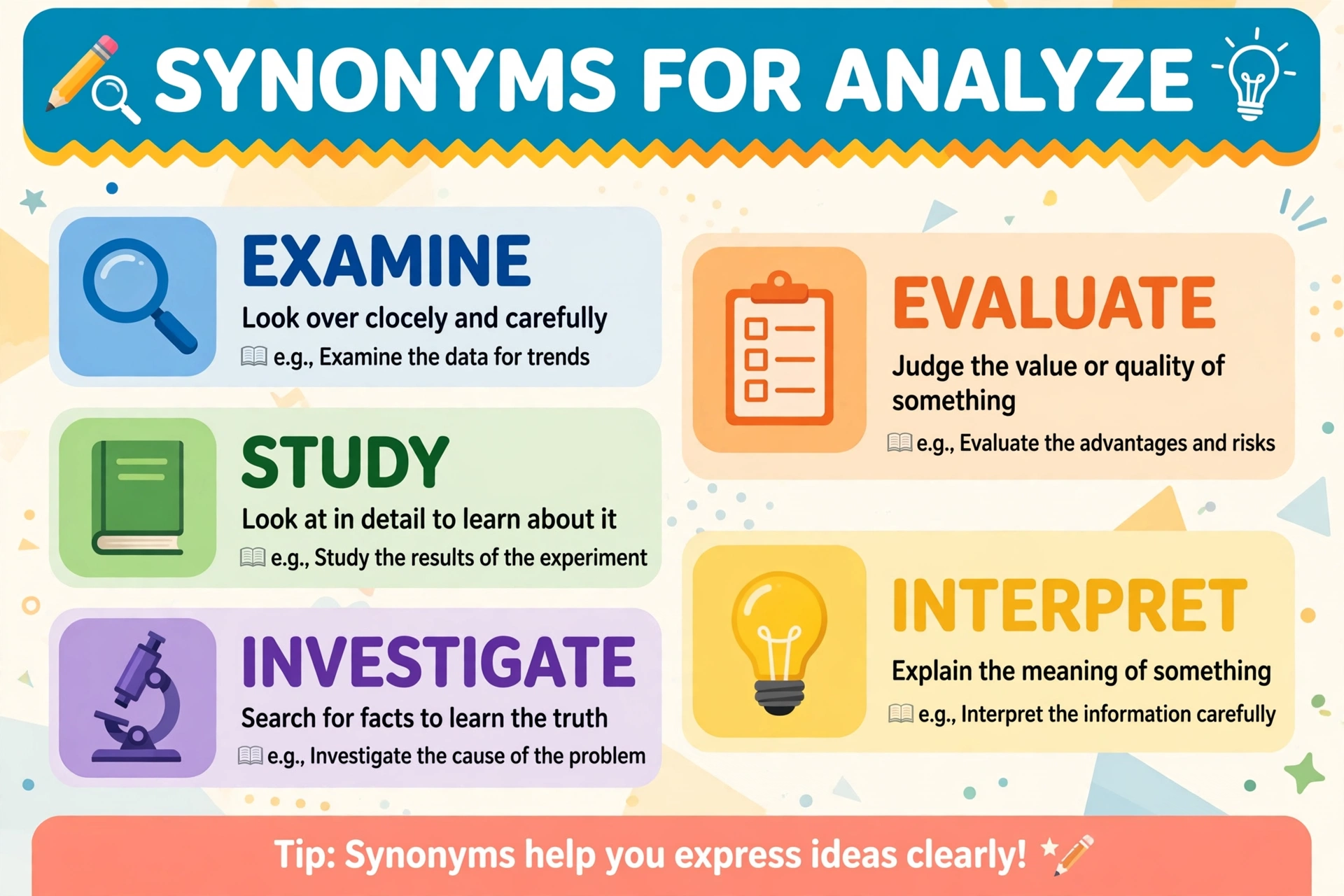
To analyze means to examine something carefully in order to understand it — breaking a problem into parts, studying data, or interpreting what something really means. Students analyze poems, scientists analyze results, and managers analyze sales figures. It is a cornerstone of academic and professional English.
From detective stories to data science, analysis is how humans turn confusion into understanding. A doctor analyzes symptoms to find the disease; a coach analyzes game footage to find the weakness; a reader analyzes a poem to find its hidden meaning. The method is always the same — look closely, break into parts, judge what matters — but English gives you different verbs for each stage. The five below will make your thinking visible on the page.
But “analyze” is overused, and its alternatives are not identical: some stress careful looking, others stress judgment, and others stress breaking things apart. Picking the right one makes your thinking sound sharper. The five below are the most useful across school and work. (Quick spelling note for essays: British and American English spell this word differently — see analyze or analyse so you stay consistent.)
Keep a short personal list of the verbs you actually use — five you truly own will serve you better than fifty you only recognize.
Examine
Meaning: To look at something very carefully and in detail in order to understand it.
Example: The doctor examined the test results before giving her diagnosis.
Example 2: The committee examined the proposal line by line.
Study
Meaning: To spend time learning about something systematically, often over a longer period.
Example: Researchers studied traffic patterns for six months.
Example 2: She studied the map before choosing a route.
Inspect
Meaning: To check something closely, usually to find faults, details, or problems.
Example: The engineer inspected the bridge for structural damage.
Example 2: Customs officers inspected every suitcase.
Evaluate
Meaning: To judge the quality, value, or importance of something after careful thought.
Example: Teachers evaluate student essays against a clear set of criteria.
Example 2: The panel will evaluate each application fairly.
Assess
Meaning: To estimate or determine the nature, quality, or extent of something.
Example: The manager assessed the risks before approving the project.
Example 2: The teacher assessed the students’ progress at term’s end.
Analyze at a Glance
A quick comparison to lock in the differences:
| Word | Tone | Use it when… |
|---|---|---|
| Examine | Neutral | looking closely at details |
| Study | Neutral | learning systematically over time |
| Inspect | Formal | checking for faults or problems |
| Evaluate | Formal | judging quality or value |
| Assess | Formal | measuring extent, risk, or impact |
How to Use These Words
Let the purpose guide you. Examine and inspect fit close physical or detailed checking — a doctor, an engineer, an editor. Study implies longer, systematic learning. Evaluate and assess add judgment: you are not just looking, you are deciding how good, risky, or valuable something is. In lab reports and essays, “analyze the data” is fine, but “evaluate the results” or “assess the impact” often says exactly what you did. Precise verbs like these lift academic writing the way precise spelling does — for instance, keeping practice vs practise straight in British English.
A practical trick: name your end goal first. If the goal is understanding, examine or study. If the goal is finding what is wrong, inspect. If the goal is a verdict — good or bad, worth it or not — evaluate or assess. Students who write “I will analyze the poem’s weaknesses” can upgrade instantly to “I will evaluate the poem’s weaknesses,” because a verdict is exactly what an evaluation delivers. Small upgrades like this compound across an entire essay.
Collocations — the words these verbs naturally pair with — deserve attention too. We examine evidence, patients, and options; we study subjects, maps, and markets; we inspect buildings, products, and luggage; we evaluate performance, proposals, and risks; we assess damage, needs, and impact. Using the expected partner makes your English sound native instantly, while a wrong pairing (“inspect the poem”) sounds translated. When in doubt, recall the phrase you have heard most often — the common pairing is usually the correct one.
Common Mistakes to Avoid
- “Analyze” for everything. Writing “analyze” five times in one essay dulls it. Rotate in “examine,” “evaluate,” and “assess” to show range.
- “Inspect” for ideas. You inspect things — bridges, bags, documents. For arguments and poems, use “examine” or “analyze.”
- “Evaluate” without criteria. To evaluate means to judge against a standard — so name it. “Evaluate the plan” is weak; “evaluate the plan against our budget” is strong.
- “Assess” as a fancy “guess.” Assessment requires evidence, not instinct. Do not write “I assess it will rain” — write “I assess the damage as severe.”
Related Words Worth Learning
- Synonyms for Ambiguous — the thinking behind good analysis
- Synonyms for Ask — analyzing without wasting effort
- Synonyms for Allow — deciding what deserves analysis first
Quick Practice
Choose the best word for each sentence:
- The mechanic ___ the brakes before the long trip. (inspected / studied)
- Scientists ___ the water samples for contamination. (examined / assessed)
- Judges will ___ the performances on creativity and skill. (evaluate / inspect)
- The manager ___ the team’s progress at the end of each month. (assessed / studied)
Answer key: 1. inspected — 2. examined — 3. evaluate — 4. assessed
FAQs
What is the best synonym for analyze in academic writing?
Examine, evaluate, and assess are the strongest academic choices. “Examine the evidence” and “evaluate the argument” are standard in essays and reports.
What is the difference between analyze and assess?
To analyze is to break something into parts to understand it. To assess is to judge its value or extent. You analyze data, then assess what it means for your decision.
Is “inspect” too narrow for general use?
It is best for physical or official checking — buildings, products, documents. For ideas and arguments, “examine” or “analyze” fits better.
Can “study” replace “analyze”?
Sometimes. “Study the results” works, but “study” suggests a longer learning process, while “analyze” suggests breaking into parts. In a lab report, keep “analyze.”
What is the noun form of “analyze”?
“Analysis” (singular) and “analyses” (plural) — note the spelling change. “The analysis took three weeks.” Many learners write “analysises”; the correct plural is “analyses.”
Is “analyze” American and “analyse” British?
Yes. American English uses “analyze”; British English uses “analyse.” Pick one and stay consistent throughout your document — mixing them looks careless.
Conclusion
Careful thinking deserves careful words. Examine for close looking, study for systematic learning, inspect for fault-finding, evaluate for judgment, and assess for measuring extent. Rotate these through your essays, reports, and professional emails, and “analyze” will stop doing all the heavy lifting alone.

Thomas Allen is a language writer and editor who loves exploring the subtle differences between words. He creates clear, practical guides that help readers understand English better — one word pair at a time.